T-money Card in Korea: Where to Buy, How to Top Up (2026)
Last updated: November 27, 2026
Quick answer: Buy a T-money card at any convenience store (CU, GS25, 7-Eleven) or a subway station kiosk, load ₩10,000–₩20,000 in cash, and tap it on every subway gate and bus. If you'll stay mostly in Seoul and ride a lot, the Climate Card tourist pass (from ₩5,000 a day for unlimited rides) can be cheaper. Bring some Korean won: cash is still the most reliable way to top up.

What a T-money card actually is
T-money is Korea's rechargeable transit card. You load money onto it, then tap it on the reader at subway gates, on buses and in most taxis. The card itself has no balance when you buy it, and you don't need a Korean ID, a phone number or an account to use it.
It works far beyond Seoul too: the same card covers subways and city buses in Busan, Daegu, Incheon and most other cities, which is why we recommend it as the default card for almost every visitor.
Local insight: Koreans tap their card twice on buses — once when boarding and once when getting off. It feels optional, but it isn't. If you skip the tap-out, the system can't calculate your free transfer, and your next ride gets charged as a brand-new trip. Locals do it without thinking; you'll hear the little beep and the word "환승입니다" (hwanseung-imnida, "this is a transfer") when it works.
Where to buy one
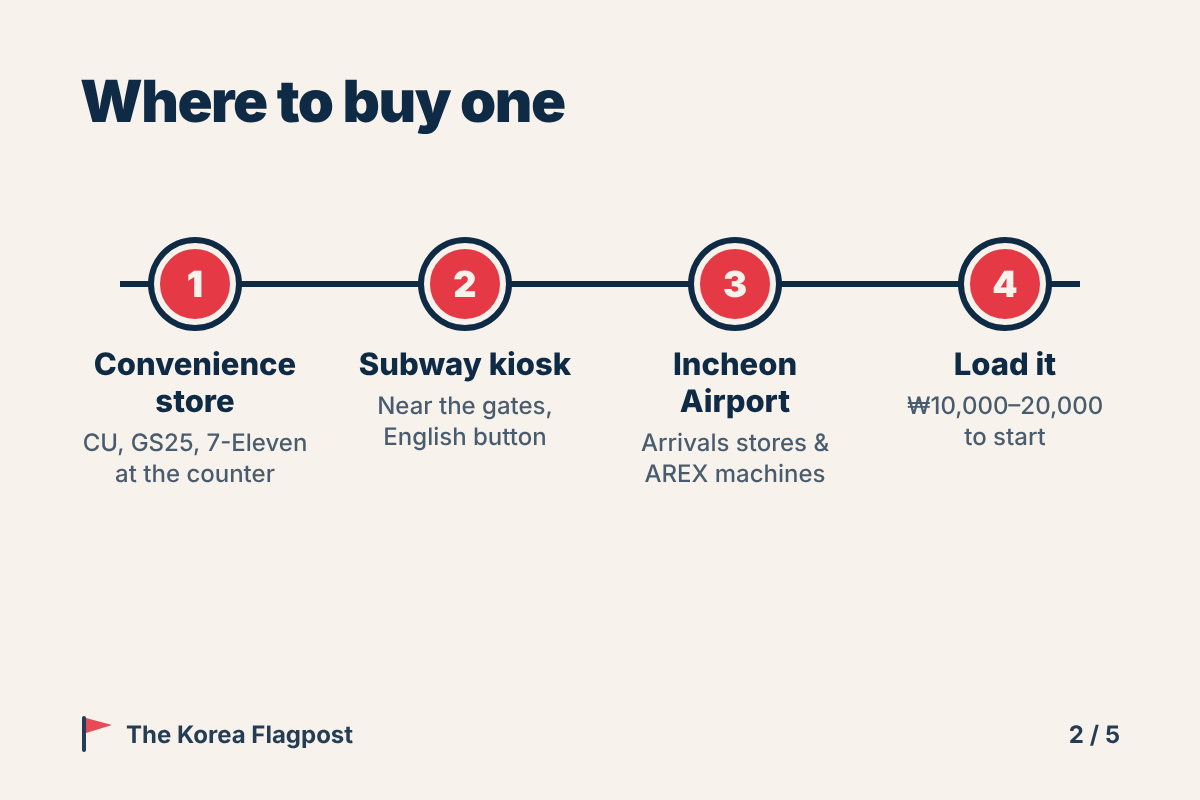
- Convenience stores: CU, GS25, 7-Eleven and emart24 sell them at the counter. Just say "T-money card" — every clerk knows it. Prices usually run ₩3,000–₩5,000 for a plain card, more for character designs.
- Subway station kiosks: look for the transit card machines near the ticket gates. They have an English button.
- Incheon Airport: convenience stores in the arrivals hall and machines near the airport railroad (AREX) gates both sell them, so you can sort it out before you even leave the airport.
The card price itself isn't refunded when you leave, so think of it as a small souvenir.
📍 Google Maps · Naver Map
How to top it up (and the cash catch)
You can add money in two main places:
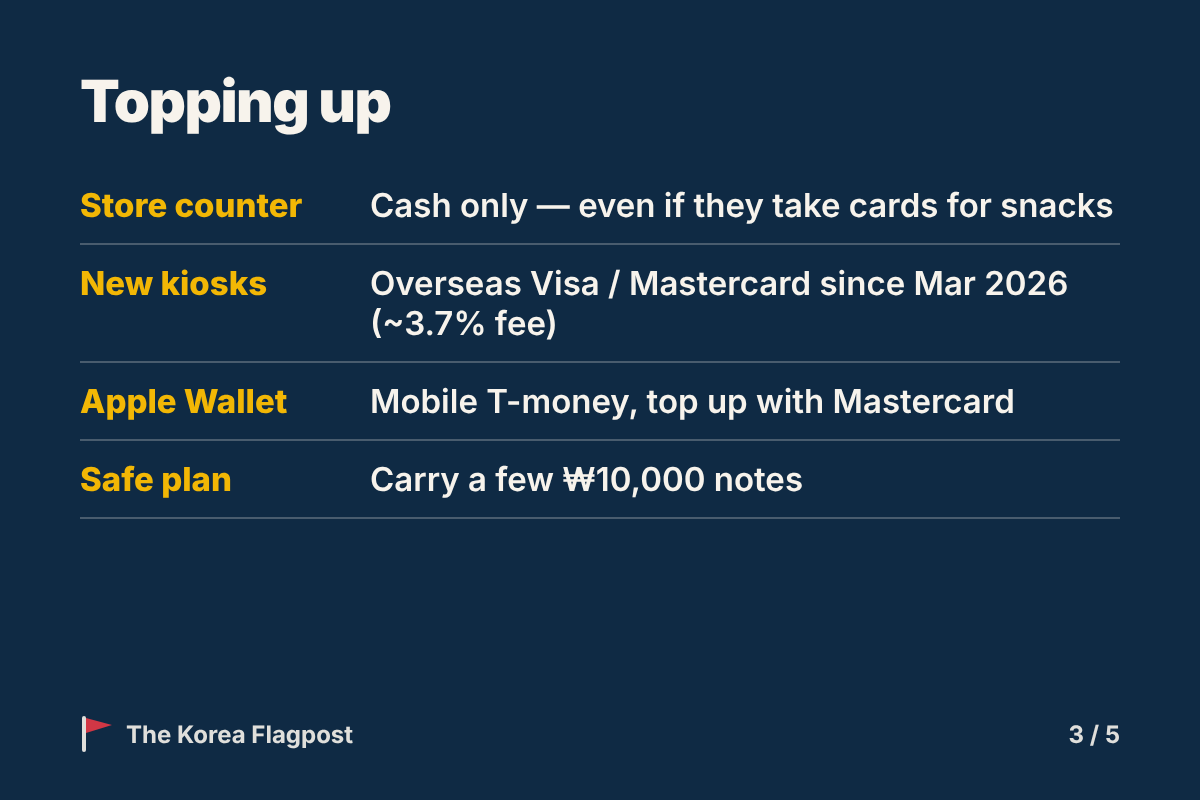
- Convenience store counter: hand over your card and say the amount, for example "만 원 충전해 주세요" (man won chungjeon-hae juseyo, "please load ten thousand won"). Expect this to be cash only, even if the store takes your credit card for snacks.
- Station kiosks: place your card on the reader, choose the amount and pay.
There's good news on the card front. Since March 17, 2026, Seoul's new transit card machines on subway Lines 1–8 accept overseas-issued Visa and Mastercard cards, as well as Kakao Pay and Naver Pay. Two catches: a service fee of about 3.7% applies to overseas cards, and some kiosks still only take cash for topping up a regular T-money balance. Card payment works most reliably for single-journey tickets and Climate Card passes. So the practical plan hasn't changed: carry a few ₩10,000 notes for top-ups, and treat card payment as a bonus when it works.
iPhone users: Mobile T-money now lives in Apple Wallet, and Mastercard holders can top it up there with their own card. Other cards may not work yet, so check before you rely on it.
How much to load
For a typical city day of three to five rides, ₩10,000–₩15,000 is plenty. Load ₩20,000 at the airport if you're taking the airport railroad into town. Don't overload it: getting leftover money back is possible at convenience stores, but there's a small fee and some limits, so it's easier to spend it down on your last day — convenience store purchases count.
T-money vs. Climate Card: which should you get?
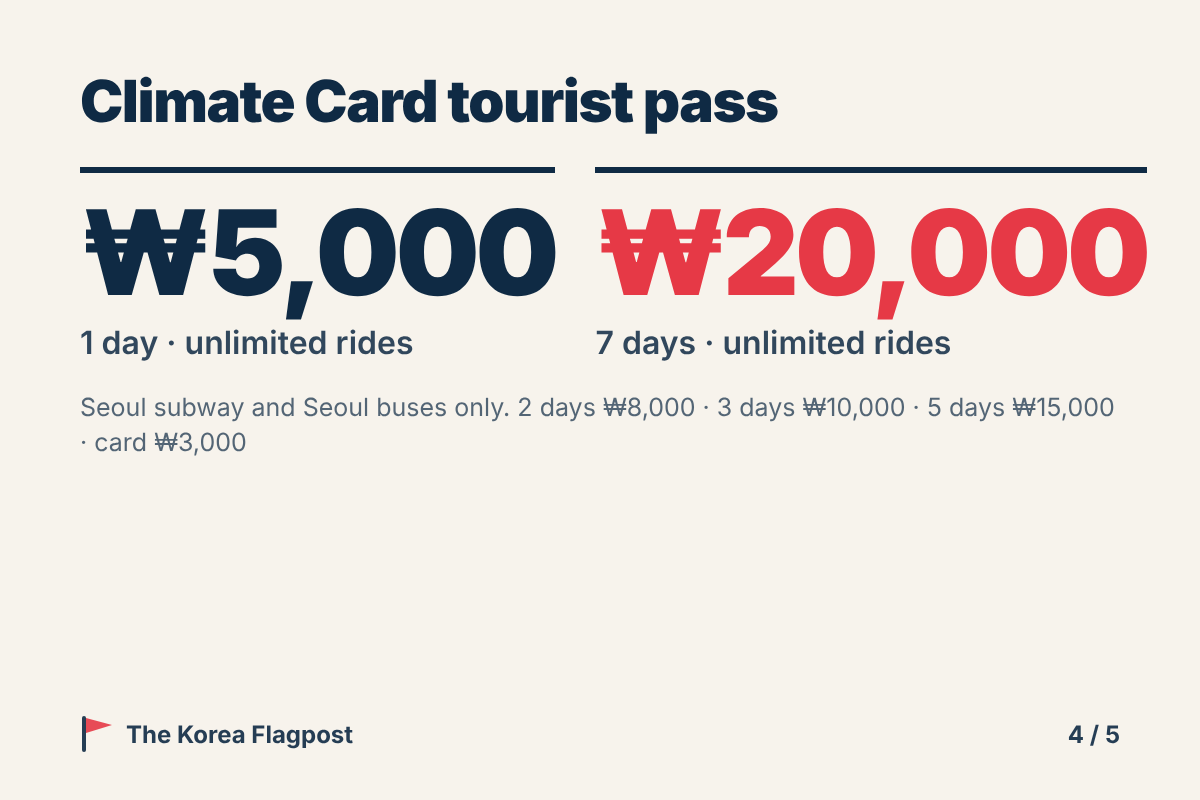
Seoul's Climate Card tourist pass gives unlimited rides on Seoul subway lines and Seoul city buses for a set number of days. Current prices are ₩5,000 for 1 day, ₩8,000 for 2 days, ₩10,000 for 3 days, ₩15,000 for 5 days and ₩20,000 for 7 days, plus ₩3,000 for the physical card. A pass starts on the day you load it and runs until the last train or bus that night.
| T-money | Climate Card pass | |
|---|---|---|
| How you pay | Per ride, from your balance | One price, unlimited rides |
| Where it works | Nationwide, plus most taxis | Seoul subway and Seoul buses only |
| Best for | Day trips, other cities, light use | Busy Seoul-only sightseeing days |
| Watch out for | Cash-only top-ups in many places | Not valid on airport railroad express or outside Seoul |
Our rule of thumb: if you'll take four or more rides a day and stay inside Seoul, get the Climate Card. If you're heading to Busan, using taxis or riding only occasionally, stick with T-money. Plenty of visitors carry both.
Using it without looking lost
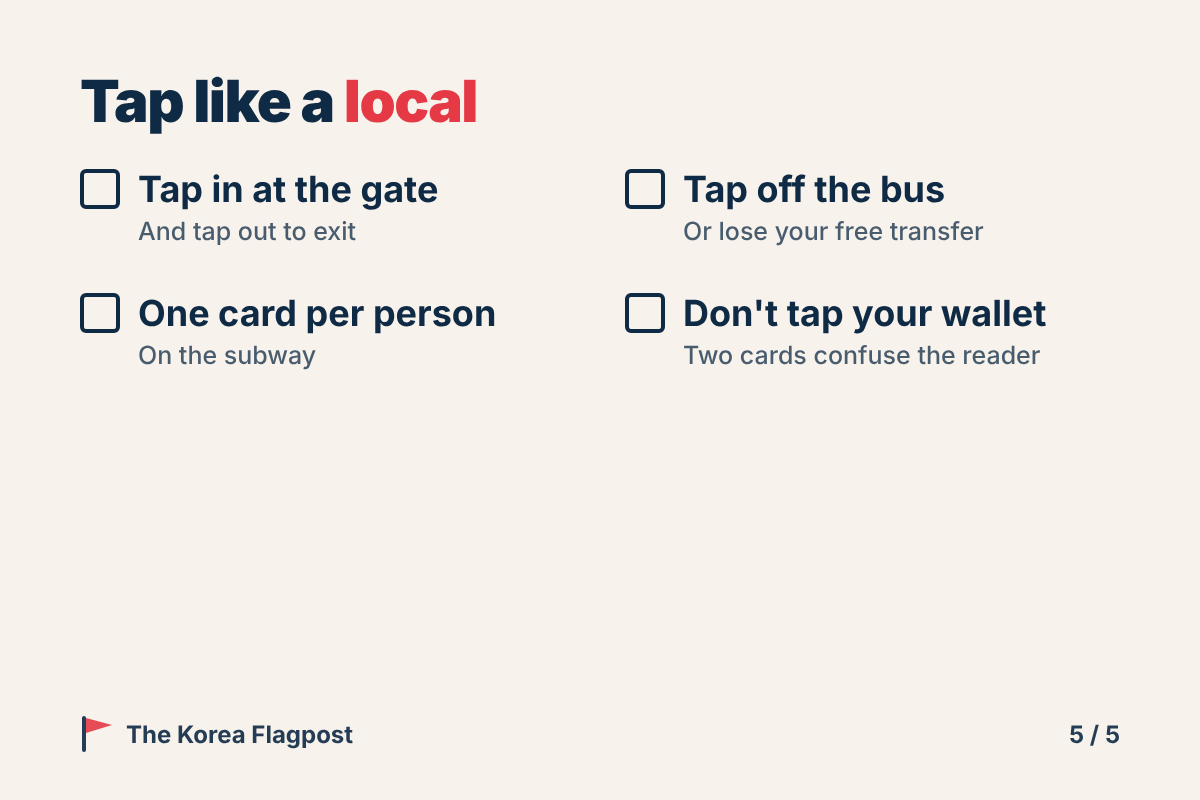
- Subway: tap on the reader at the gate going in and again coming out. The fare depends on distance.
- Bus: tap at the front door when boarding and on the reader by the back door when you get off.
- Transfers: switching between subway and bus within about 30 minutes is usually free or discounted, as long as you tapped out properly.
- Check your balance: the gate screen shows it after each tap. If it reads low, top up at the next convenience store.
- Only one card at a time: don't tap your whole wallet. If two cards sit together, the reader may charge the wrong one or reject both.
FAQ
Can I tap my foreign credit card directly at the subway gate?
Not yet. Seoul is working on letting visitors tap Visa and Mastercard cards directly, but for now you need a T-money card, a Climate Card or a single-journey ticket.
Does T-money expire?
The card doesn't have a set expiry date, so you can keep it for your next trip.
Can I share one card with a friend?
Not on the subway, where each person needs their own card. Buses technically allow multiple fares on one card, but it's easier for everyone to have their own.
Sources: Korea.net on overseas card payments at Seoul subway kiosks (March 2026), Mastercard on Mobile T-money in Apple Wallet, and Seoul Metropolitan Government information on Climate Card tourist passes. Fares and kiosk features change, so check the machine screen before you pay.


Comments
Post a Comment