Korean BBQ in Korea: How to Order, Grill, Wrap and Pay (2026)
Last updated: November 28, 2026
Quick answer: At a Korean BBQ restaurant in Korea you order meat by the serving (usually two servings to start), and the side dishes, lettuce and sauces come free with unlimited refills. Either you or the staff grill the meat at your table, it gets cut with scissors, and you eat it wrapped in a lettuce or perilla leaf with ssamjang. There's no tipping; you pay at the counter on the way out. In Seoul, a 200g serving of pork belly averaged ₩21,321 (about US$16) in June 2026, per the Korea Consumer Agency.
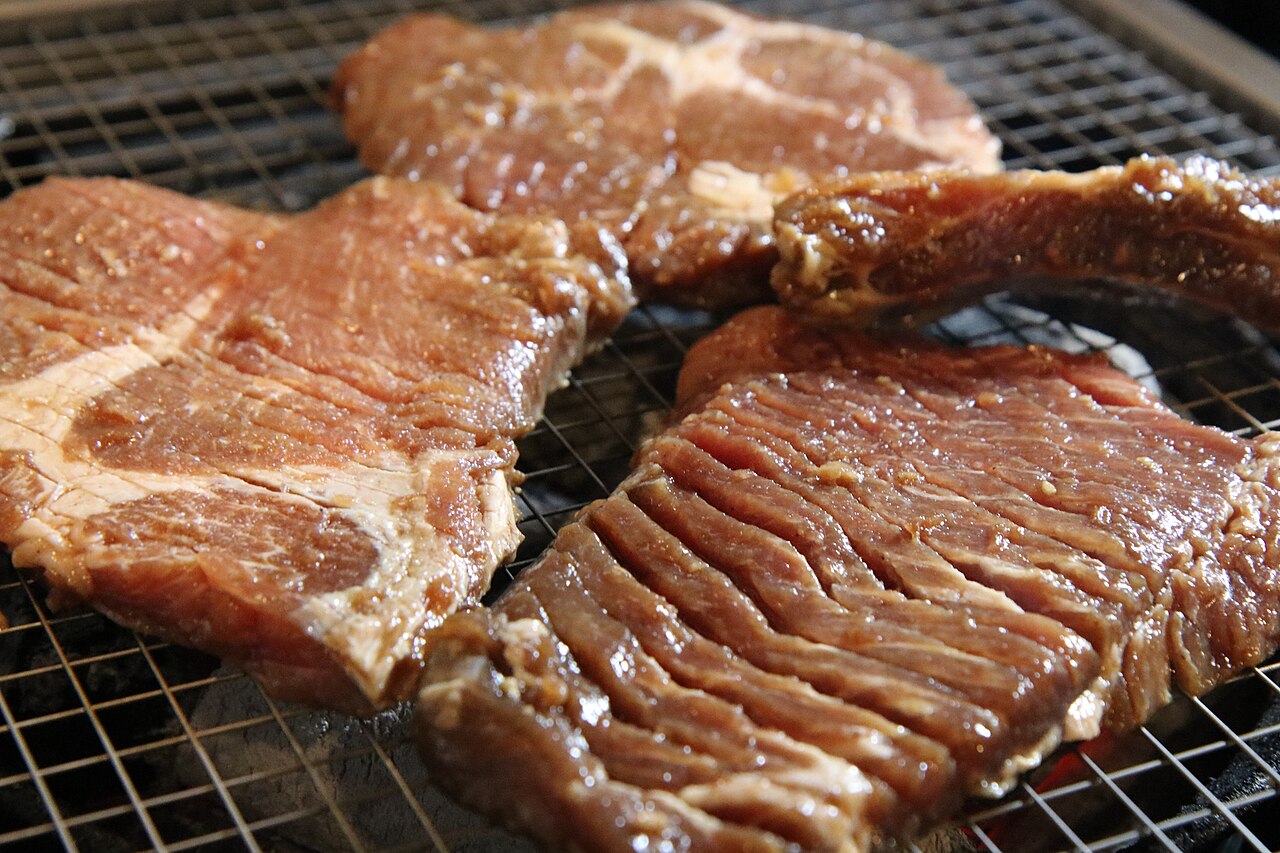
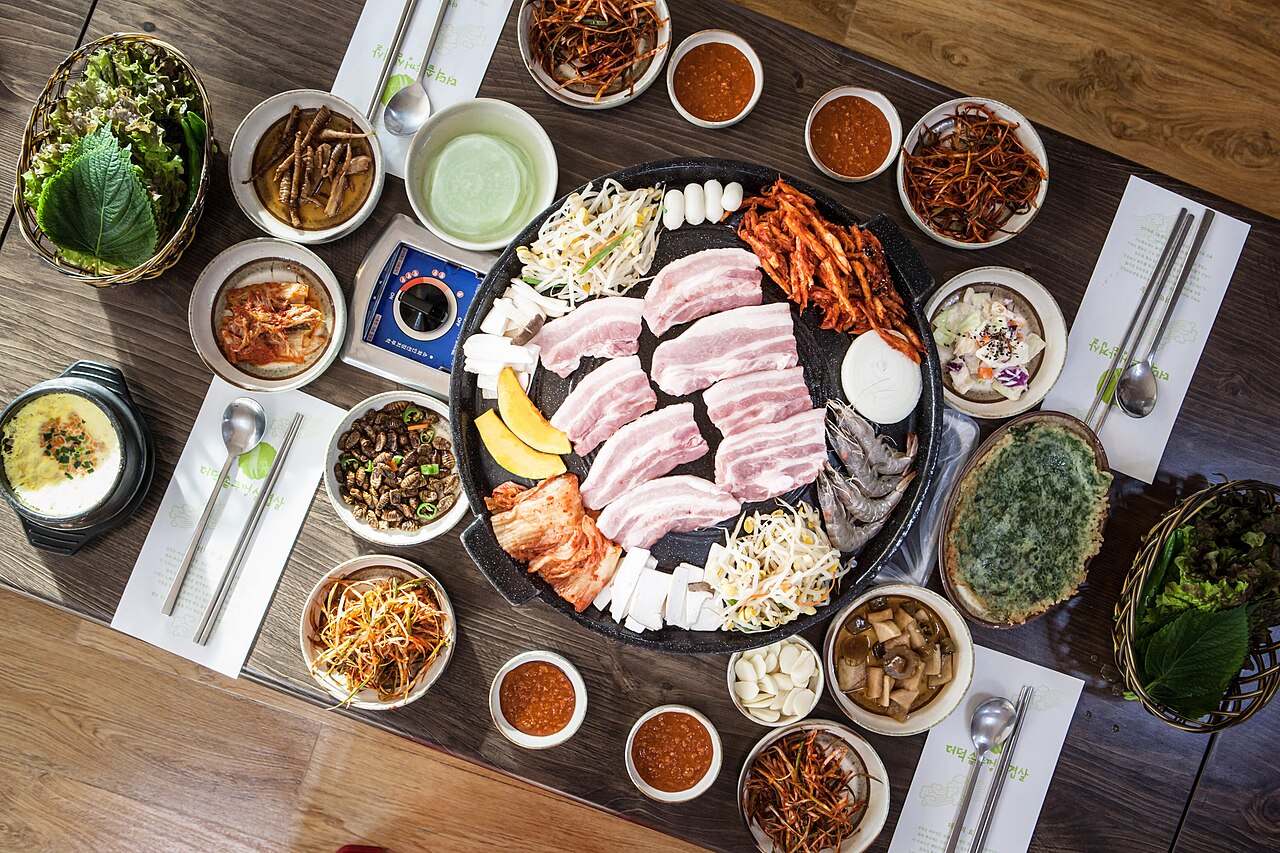
The first surprise is the hole in the middle of the table. Within a minute of sitting down, someone may slide a tray of glowing charcoal into it, drop a grill on top and lower an extractor hood over your head. Then the small dishes arrive, six or eight of them, before you've ordered a thing. None of it is a mistake, and none of it costs extra.
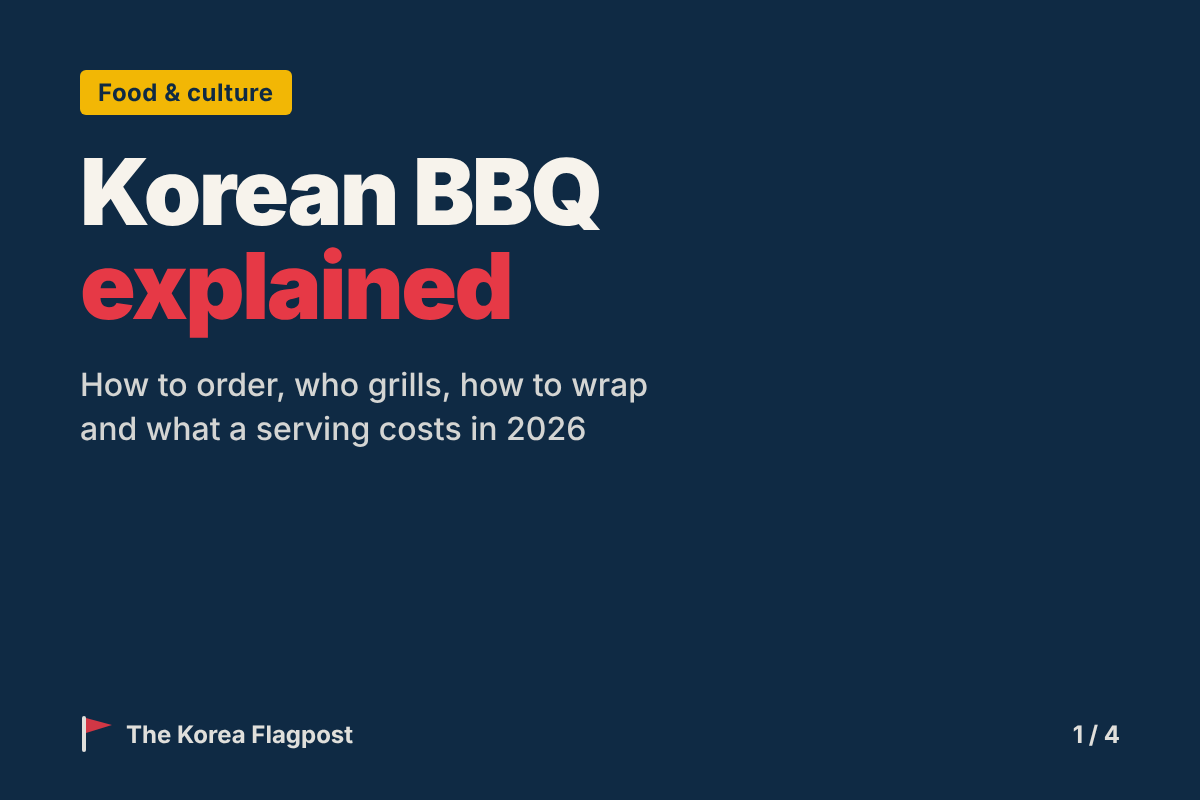
Korean BBQ (고기구이, gogi-gui, "grilled meat") is less a dish than a social ritual with a grill in the middle. Here's how it actually works in Korea, from reading the menu to paying the bill.
What's on the menu: the cuts worth knowing
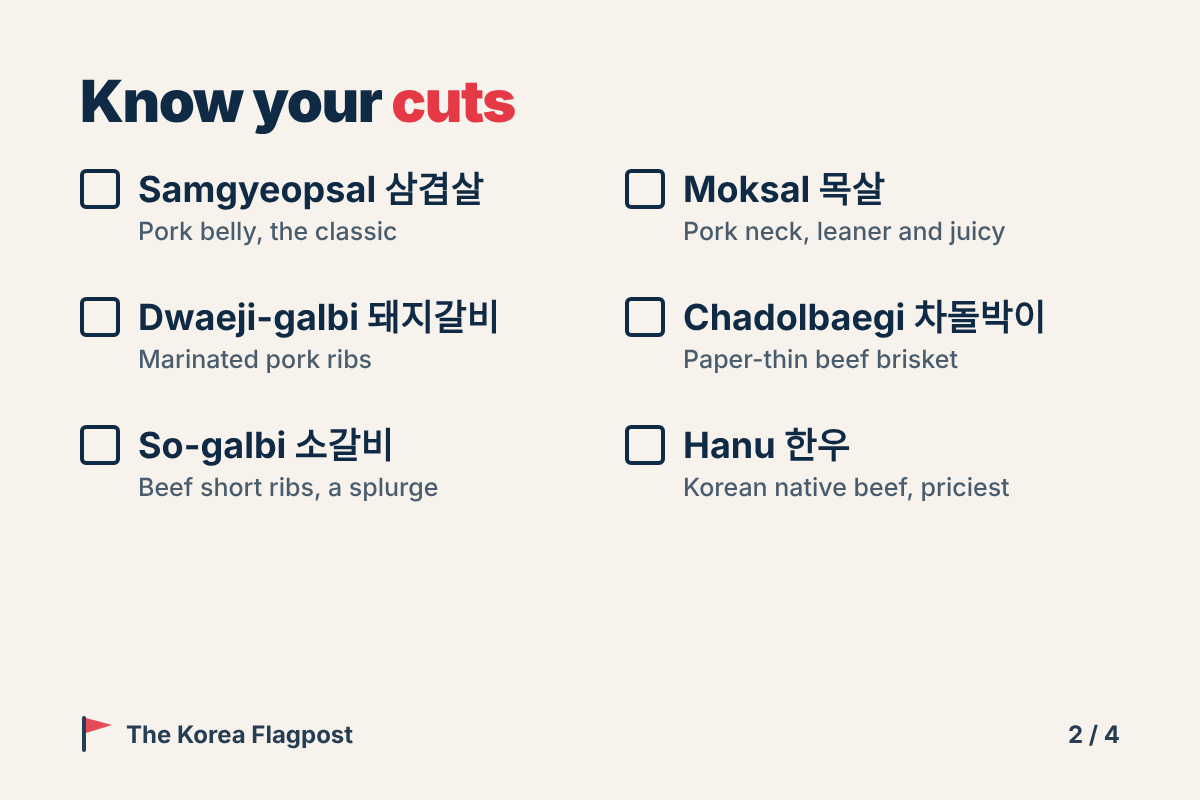
Most BBQ places specialize. A samgyeopsal-jip focuses on pork, a galbi-jip on marinated ribs, and a hanu restaurant on Korean native beef. Menus list meat per 인분 (inbun), meaning "one person's serving," with the weight printed next to it. That weight varies between restaurants, so compare grams rather than prices alone.
| Cut | Korean | What it is | Who grills it, usually |
|---|---|---|---|
| Samgyeopsal | 삼겹살 | Thick, unmarinated pork belly; the national favorite | You, at casual places |
| Moksal | 목살 | Pork neck and shoulder; leaner, still juicy | You |
| Dwaeji-galbi | 돼지갈비 | Pork ribs in a sweet soy marinade | Often staff (the sugar burns fast) |
| Chadolbaegi | 차돌박이 | Paper-thin beef brisket that cooks in seconds | You |
| So-galbi | 소갈비 | Beef short ribs, plain or marinated | Usually staff |
| Hanu | 한우 | Korean native beef, graded and priced like a luxury | Usually staff |
Our pick for a first time: samgyeopsal. It's the meat VisitKorea calls the most popular in the country, it's forgiving on the grill, and it's the cheapest way to learn the whole routine. Save hanu for a second night, when you know what you're paying for.
How to order (and what it costs in 2026)
- Sit down first. Seating is usually casual; staff point you to a table. You rarely wait for a host stand.
- Order by the serving. Many BBQ places ask for at least two servings on the first order, because each table needs its own grill and coals. Say 삼겹살 2인분 주세요 (samgyeopsal i-inbun juseyo, "two servings of pork belly, please").
- Add drinks and extras. Soju, beer, a stew or rice can be ordered now or later.
- Call the server when you need them. Press the bell on the table if there is one. If not, raise a hand and say 여기요 (yeogiyo, "excuse me, over here"). It's polite here, not rude.
Prices have climbed steadily. According to the Korea Consumer Agency's Chamgagyeok restaurant price data, a 200g serving of pork belly in Seoul averaged ₩21,321 in June 2026, up 4.3% on a year earlier. The national average across all provinces was ₩17,906 in September 2026. Beef, and hanu especially, costs noticeably more, so check the menu board before you order a round.
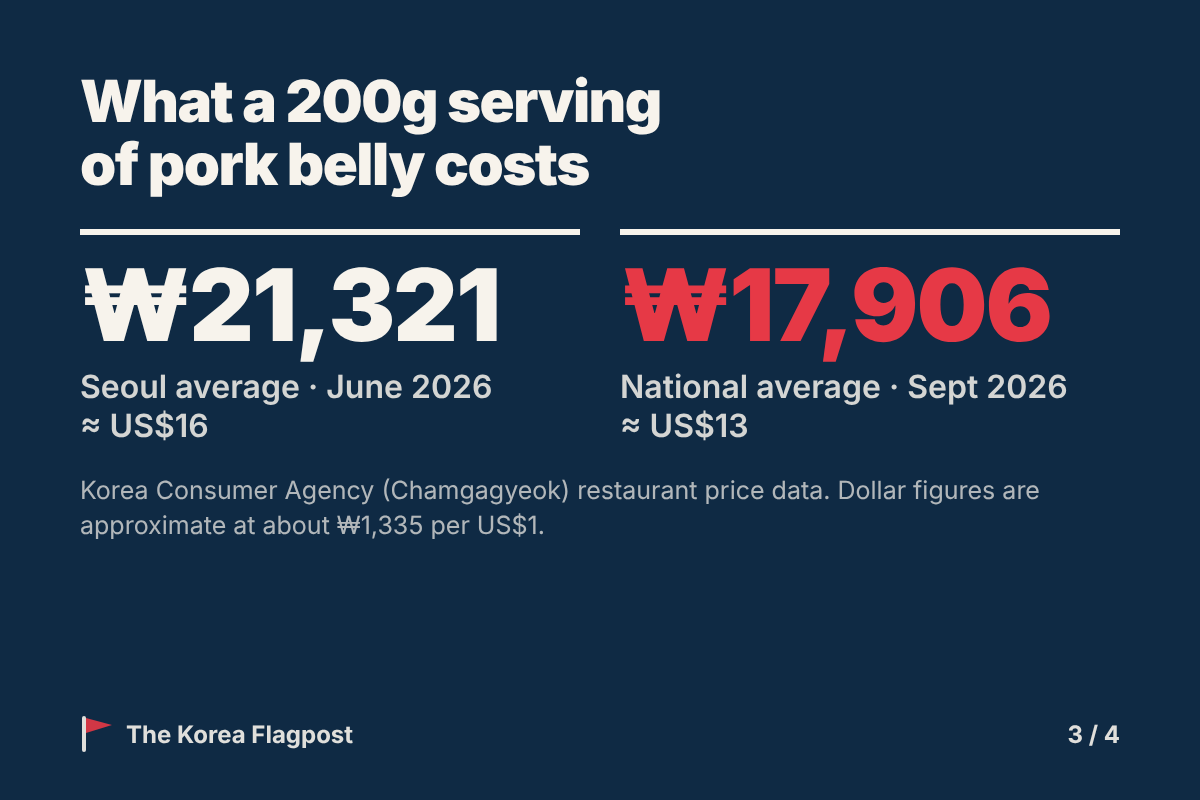
For budgeting, two hungry people usually order three servings of pork plus a stew or fried rice and a couple of drinks. At Seoul averages, the meat alone for three servings comes to roughly ₩64,000, or about US$48 (approximate, at about ₩1,335 to the dollar). Drinks, rice and noodles are extra. Outside Seoul, expect to pay less.
Who grills: you, or the staff?
It depends on the restaurant and the meat. At a busy pork place you'll usually do it yourself. At galbi and beef restaurants, a server often grills for you, because marinated meat and expensive cuts are easy to ruin. VisitKorea notes that some places grill for the table; if a staff member reaches for the tongs, let them.
If it's your turn, keep it simple:
- Lay the strips flat and leave them alone until the bottom is golden. Flip once, maybe twice.
- Use the scissors provided to cut the meat into bite-size pieces right on the grill. Scissors are normal kitchen tools in Korea, not a sign of a cheap restaurant.
- Push cooked pieces to the cooler edge of the grill so they don't char. Garlic slices and kimchi can go on the grill too; they pick up the pork fat.
- If the grill turns black and sticky, ask for a new one: 불판 좀 갈아 주세요 (bulpan jom gara juseyo, "could you change the grill, please?"). Staff do this all night without a second thought.
Banchan and ssam: building the perfect wrap
The small dishes are 반찬 (banchan): kimchi, pickled radish, seasoned sprouts, a green-onion salad, maybe steamed egg. They're included, and VisitKorea confirms that asking for more side dishes or water costs nothing. Some restaurants have a self-service refill bar; if you see one, help yourself.
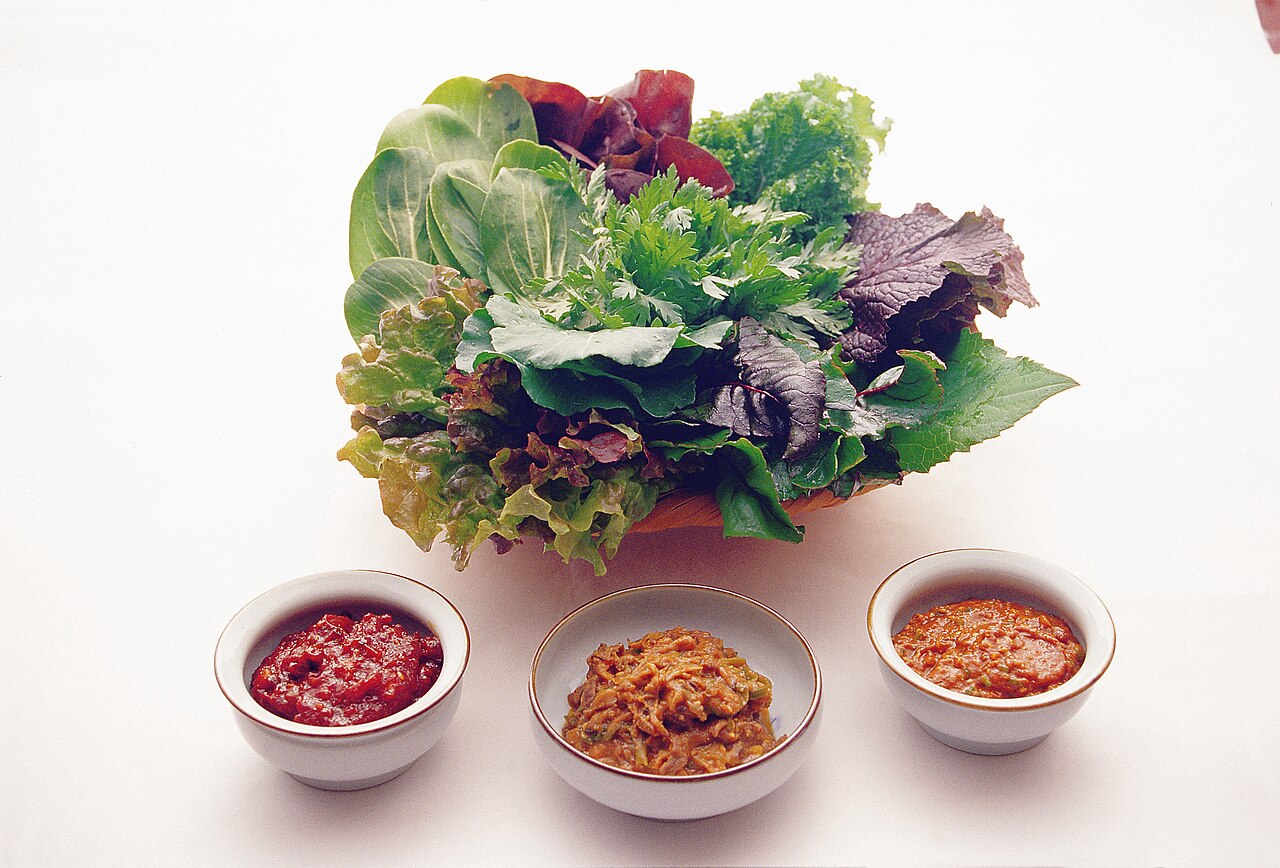
The basket of leaves is for 쌈 (ssam), a hand-held wrap. VisitKorea describes the method simply: meat on a lettuce or perilla leaf, a dab of ssamjang, then into your mouth in one go.
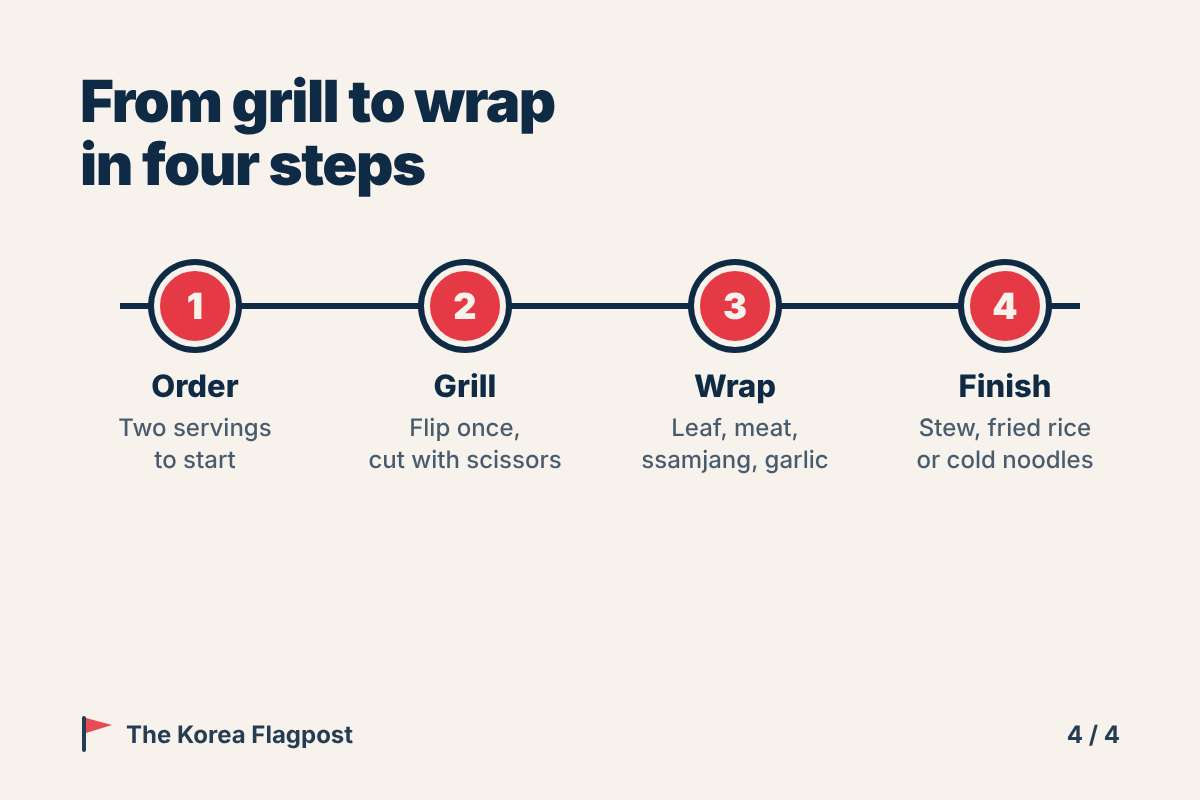
- Hold a lettuce leaf (or a perilla leaf, 깻잎, kkaennip, for a minty kick) flat in your palm.
- Add one piece of meat, dipped in sesame oil and salt if you like.
- Top with a little 쌈장 (ssamjang, thick soybean-chili paste), a slice of raw or grilled garlic and some green-onion salad.
- Fold it closed and eat it in one bite. Biting a ssam in half usually ends with it in your lap.
Local insight: Korean BBQ is built for sharing, and that's the point. Everyone eats from one grill, so whoever handles the tongs is quietly looking after the group: turning the meat, putting the best pieces in front of others. In a mixed-age group the younger people often take the job without being asked. If you take a turn at the grill, you've joined the table, not just eaten at it.
Drinks and table manners at the grill
Pork and soju are a classic match, and so is 소맥 (somaek), soju mixed into beer. VisitKorea notes that the popular way to mix it is to tap a chopstick against the one standing in the glass so the drink fizzes up. Cheering with 건배 (geonbae, "cheers") is the norm.
A few habits go a long way, especially with Korean friends or colleagues who are older than you:
- Pour for others, not yourself. Keep an eye on the glasses around you and top them up. Someone will return the favor.
- Use two hands with elders. Korea.net explains that when you pour for or accept a drink from someone older, you hold the bottle or glass with both hands.
- Turn slightly away to drink. In front of an older person, turn your head a little to the side as you sip. It's a small sign of respect that Korean elders notice.
- Let the eldest start eating. Younger diners traditionally wait for the most senior person to pick up their utensils first.
Among friends of the same age, most of this relaxes. Nobody expects visitors to get it all right; trying is what counts. Our Korean etiquette guide for first-time visitors covers the wider rules, from shoes to subway seats.
Finishing the meal and paying
When the meat runs low, Koreans rarely just stop. VisitKorea suggests rounding off with 된장찌개 (doenjang-jjigae), a soybean-paste stew with rice, or fried rice cooked on the grill plate with the leftover juices. Cold noodles, 냉면 (naengmyeon), are another favorite finish, even in winter.
Then stand up and pay at the counter by the door. Cards are accepted nearly everywhere, and splitting the bill is fine if you ask the cashier. Tipping is not required or expected in Korea, according to VisitKorea, so don't leave cash on the table. A cheerful 잘 먹었습니다 (jal meogeosseumnida, "I ate well") to the staff on your way out is the local thank-you.
Where to try it in Seoul
Honestly, you don't need a special destination: look for 고기 (gogi, "meat") or 숯불 (sutbul, "charcoal") on a sign in any busy neighborhood. If you want a destination, though, these are worth the trip.
Majang Meat Market
VisitKorea calls Majang Meat Market (마장축산물시장) the largest meat market in Korea. Rows of butchers sell beef and pork at prices VisitKorea says can be up to 30% below supermarket chains. Nearby restaurants will often grill meat you bought at the market for a per-person table-setting charge (상차림비, sangcharim-bi); ask the price before you sit down. The market lists hours of 03:00 to 23:00 and closes on the first and third Sunday of each month, as of November 28, 2026. It's a short walk from Majang Station on Line 5.
📍 Google Maps · Naver Map (Naver Map gives better walking and transit directions in Korea.)
Wangsimni Gopchang Street
For something bolder, Visit Seoul highlights Wangsimni's gopchang (곱창) alley around Doseon Sageori in Haengdang-dong, where restaurants grill beef and pork intestines at the table. It pairs well with Majang, a short ride away in the same district.
📍 Google Maps · Naver Map
Mapo Sutbulgalbi (Gangnam)
Despite the name, this galbi house sits on Dosan-daero in Gangnam. Visit Seoul recommends its bone-in pork galbi and lists it as open daily from 11:00 to 06:00, which makes it a rare late-night option. It's roughly a 10-minute walk from Apgujeong Station (Line 3), Exit 3.
📍 Google Maps · Naver Map
FAQ
Can I eat Korean BBQ alone?
Yes, but it takes a little planning. Many BBQ restaurants want at least two servings per order, so a solo diner either orders two servings or looks for a place advertising 1인분 (single-serving) or 혼밥 (honbap, "eating alone") options. Going outside the dinner rush also helps.
Do I need to tip at a Korean BBQ restaurant?
No. Tipping is not required or expected in Korea, and the side dishes and refills are already included. Pay the bill at the counter and say thank you.
How much should I budget for Korean BBQ in Seoul?
If two people share three servings of pork, the meat alone comes to roughly ₩32,000 (about US$24) per person at the June 2026 Seoul average of ₩21,321 per 200g. Add a shared stew or fried rice and drinks on top. Beef and hanu restaurants cost considerably more.
Sources: VisitKorea: About Korean Food (gogi-jip, samgyeopsal, ssam); VisitKorea: About Korean Food (tipping, free refills); VisitKorea: How to Drink Like a Korean; Korea.net: table and drinking manners; VisitKorea: Majang Meat Market; Visit Seoul: Legendary restaurant alleys; Visit Seoul: Mapo Sutbulgalbi; Korea Consumer Agency Chamgagyeok (restaurant price data). Prices and hours were checked on November 28, 2026; dollar figures are approximate. Please confirm current prices and opening hours before you go.


Comments
Post a Comment